Imagine this.
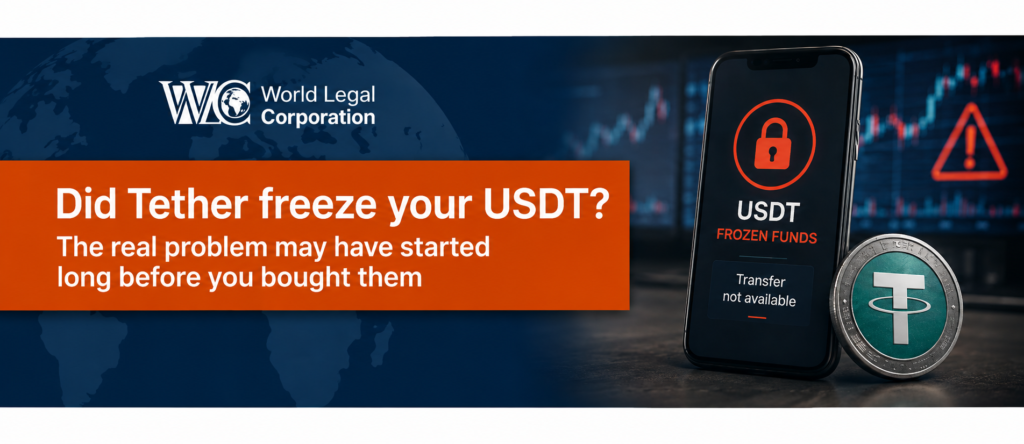
You purchase USDT through what appears to be a perfectly legitimate transaction. You pay for the assets. The USDT arrives in your wallet. Nothing unusual happens. Weeks or months later, you try to move the funds. You can’t. Your account may have been restricted by an exchange, a wallet address may be affected by a freeze, or certain USDT may no longer be transferable. Your immediate reaction is understandable: «But these are my funds. I purchased them legitimately. I had nothing to do with any fraud.» That may be entirely true. Legally, however, that statement is only the beginning of the investigation.
The first question is not why. It is who.
Before challenging a restriction, there is a fundamental question: Who actually caused the assets to be restricted? Not every freeze is the same. The restriction may have been imposed by an exchange. It may involve action affecting USDT at the Tether level. It may arise from sanctions, AML controls, a fraud investigation or another compliance concern. Or there may be a request or order from a competent authority. The distinction matters. If an authority originated the measure, challenging Tether alone may not address the underlying problem.
Blockchain remembers transactions you may never have known existed
Consider a common scenario. You purchase USDT from an intermediary. That intermediary receives digital assets from multiple wallets and counterparties. Before reaching you, some of those USDT may have moved through several other addresses. Three, five or ten transactions earlier, part of the funds may have interacted with an address that was – or later became – associated with fraud, theft, sanctions or another investigated activity. You may never have known that wallet existed. You never dealt with its owner. You had no involvement in the transaction that created the concern. But the blockchain remembers the path. Blockchain can establish a connection. A connection does not automatically establish legal liability.
A blockchain transaction does not tell the entire legal story
Blockchain analytics can establish that assets moved between specific addresses. But that fact alone will not normally answer several critical questions. Who actually controlled each wallet? What was the purpose of each transfer? What did the purchaser know when the USDT was acquired? Was the exposure direct or several hops removed? What percentage of the funds was actually exposed? Was the relevant address already considered high-risk when the transaction occurred? Or was that attribution created later? These are not minor details. They may fundamentally change the legal analysis. Technology reconstructs movements. Law must determine what those movements mean for a particular person, transaction and set of facts.
“I didn't know” is not enough
One of the most common mistakes in these situations is relying entirely on a simple defense: «I didn’t know where the USDT came from.» That statement may be true. But a serious claim should be built on evidence, not merely an assertion. Where did the money used to purchase the USDT come from? Who was the seller or intermediary? When did the transaction take place? At what price? How was payment made? Are there bank records? Contracts? Invoices? Commercial communications? Wallet addresses and transaction IDs? What risk information was reasonably available when the assets were acquired? Good faith becomes far more persuasive when it can be reconstructed through objective evidence.
This is where blockchain forensics meets legal strategy
Blockchain analytics can help reconstruct the movement of digital assets and identify exposure to other wallets, exchanges, services or addresses associated with particular risks. But a sophisticated-looking diagram filled with arrows and wallet addresses does not resolve a legal dispute. The important part is knowing what questions to ask. Which address actually triggered the alert? How many hops separate that address from the client’s assets? What percentage of the funds is exposed? What is the source of the attribution? And critically: when did that attribution first exist? Timing can matter enormously.
So what do we do when USDT is frozen?
We do not begin by sending demands in every direction. We begin by reconstructing the case. Step 1 – Determine what actually happened. Identify the blockchain network, exact wallet address and relevant transaction IDs, and confirm the nature of the restriction. Step 2 – Identify who originated the measure. Was it Tether? An exchange? A government authority? Is there an investigation, court order, sanctions issue or compliance measure? Step 3 – Reconstruct the history of the assets. This is where blockchain evidence and traditional evidence come together: source of funds, purchase documentation, information regarding the seller or intermediary, banking records, evidence of legitimate control of the wallet, transaction chronology, and where appropriate, blockchain forensic analysis. Step 4 – Build the evidence before building the argument. A serious claim should be supported by verifiable evidence.
The best frozen-wallet case may be the one you prevent
Anyone conducting significant USDT transactions should think about evidence before a problem arises. Knowing your counterparty – KYC – remains important. But in digital-asset transactions, it may not be enough. You may also need to understand the transaction itself and the historical exposure of the assets you are receiving – KYT. For significant transactions, obtaining wallet screening before accepting USDT can later become valuable evidence because it can help establish what risk information actually existed at the moment the assets were acquired.
Digital assets move globally. Legal problems follow them.
USDT can move across wallets, exchanges and jurisdictions in minutes. Resolving a restriction may be considerably more complicated. The matter can involve private companies, compliance departments, blockchain analytics, banking documentation and authorities operating in different jurisdictions. These disputes therefore do not belong exclusively to the crypto world. They are disputes involving evidence, ownership, compliance, investigation and cross-border legal strategy operating on blockchain infrastructure.
How World Legal Corporation approaches these matters
At World Legal Corporation, we approach digital-asset disputes by combining legal analysis, transaction chronology, financial evidence and blockchain forensic analysis when appropriate. Our first objective is not to promise an outcome before understanding the facts. It is to answer the questions that actually determine the case: Who restricted the assets? Why? What is the actual blockchain connection being questioned? What did the owner know when the assets were acquired? Can legitimate ownership, source of funds and good faith be documented? And where should the legal challenge actually be directed? Because when digital assets are frozen, identifying the problem is only the beginning. The real work is reconstructing how the problem reached you.cross-border legal strategy operating on blockchain infrastructure.